Cracking the Code on iGaming Valuations: Metrics Fueling Million-Dollar Casino Site Sales
Cracking the Code on iGaming Valuations: Metrics Fueling Million-Dollar Casino Site Sales

The Surge in iGaming Asset Deals
Online casino platforms fetch eye-watering prices these days, with valuations often hitting seven figures or more, especially when certain metrics align just right; data from recent transactions reveals that top-performing sites command premiums up to 10 times their annual earnings, driven by booming player engagement and regulatory stability across global markets. Buyers scour marketplaces for turnkey operations boasting strong fundamentals, while sellers leverage these same indicators to justify lofty asking prices. Turns out, it's not just about flashy designs or game libraries—it's the numbers underneath that seal the deal.
Observers in the industry point to a spike in mergers and acquisitions over the past couple of years, fueled by maturing tech infrastructures and expanding player bases in regulated jurisdictions; for instance, platforms with proven scalability sell faster, often at multiples that reflect their potential to dominate niche markets like live dealer games or crypto-integrated betting. And as investor interest grows, those who've tracked these sales note how metrics like recurring revenue streams become the real currency in negotiations.
Gross Gaming Revenue: The Cornerstone Metric
Gross Gaming Revenue, or GGR, stands as the bedrock of any iGaming valuation, representing the total wagers minus payouts to players, and figures show that sites generating over $5 million annually in GGR routinely attract bids at 4-6x multiples; high-GGR platforms benefit from economies of scale, where marketing costs drop per user as volumes rise, making them magnets for private equity firms eyeing quick returns. But here's the thing—seasonal fluctuations matter less than consistent year-over-year growth, with data indicating that sites posting 20%+ annual GGR increases command 25% higher premiums compared to stagnant peers.
Take one European operator that flipped a mid-tier site last year; its steady GGR climb from €2 million to €4.5 million over 18 months, bolstered by diverse slot and table game offerings, pushed the final sale price to €18 million, or roughly 4x trailing revenue. Researchers analyzing such deals emphasize how GGR diversification—spanning slots, blackjack, and progressive jackpots—shields against market dips, turning solid earners into premium assets.
EBITDA Margins: Profitability Under the Hood
EBITDA, earnings before interest, taxes, depreciation, and amortization, cuts through revenue noise to spotlight operational efficiency, and platforms boasting 30%+ margins see valuations soar because they signal lean operations ripe for scaling; unlike raw GGR, this metric accounts for affiliate payouts, server costs, and compliance overheads, revealing true cash flow potential. Studies from industry analysts reveal that top-quartile sites with EBITDA exceeding $1 million per quarter trade at 8-12x multiples, far outpacing lower-margin competitors mired in high churn.
What's interesting is how tech optimizations drive these margins; sites integrating AI-driven personalization for player retention often report EBITDA jumps of 15-20%, as retention costs plummet while lifetime values climb. One case saw a North American-focused platform, optimized for mobile-first users, boost its EBITDA from 22% to 38% through automated fraud detection and dynamic bonus engines, ultimately selling for a price that reflected its bulletproof profitability profile.
Player Metrics: Retention and Lifetime Value Magic
Active user counts paired with retention rates form the lifeblood of premium valuations, where sites retaining 40%+ of monthly players at a lifetime value exceeding $500 per user fetch outsized multiples; data from American Gaming Association reports underscores how U.S.-facing platforms with low churn—under 15% monthly—correlate directly with 2-3x higher sale prices, since sticky audiences promise steady revenue without endless acquisition spends. Yet, it's the LTV-to-CAC ratio that seals premium status; ratios above 3:1 signal efficient growth machines, turning one-time depositors into loyal high-rollers.
People who've dissected successful flips often highlight hybrid models blending VIP programs with gamification; consider a site that layered loyalty tiers atop crash games and live roulette, lifting its 90-day retention from 25% to 52% while LTV doubled to $750, paving the way for a $12 million exit at 9x EBITDA. Such metrics don't just impress buyers—they forecast dominance in competitive landscapes.
Traffic and Acquisition Efficiency
Organic traffic volumes, SEO rankings, and customer acquisition costs paint the growth trajectory, with sites pulling 500,000+ monthly visitors via strong domain authority commanding 30% valuation uplifts; low CAC under $150 per depositor, especially when paired with high conversion rates above 5%, makes platforms acquisition targets for conglomerates seeking instant scale. Figures from global benchmarks indicate that SEO-optimized sites with backlink profiles from high-authority gambling directories reduce reliance on paid ads, slashing costs by up to 40% and inflating multiples accordingly.
And then there's the mobile angle; platforms optimized for seamless cross-device play see traffic retention spikes of 25%, as users stick around longer on apps with fast load times and intuitive UX. One aggregator site, revamping its mobile casino lobby to prioritize touch-friendly slots and instant withdrawals, watched organic traffic double while CAC halved, culminating in a sale that valued its audience pipeline at a steep premium.
Licensing, Tech Stack, and Compliance Edge
Regulatory licenses from bodies like the Malta Gaming Authority act as valuation multipliers, enabling access to premium markets and slashing perceived risks; tier-1 licensed sites trade at 20-50% higher multiples than white-label setups in gray zones, since buyers prioritize setups compliant with AML and RNG standards. Robust tech stacks—think proprietary CMS integrated with payment gateways supporting crypto and fiat—further elevate prices, with platforms on scalable cloud infrastructures fetching bids 15% above legacy systems.
Compliance isn't sexy, but it's where the rubber meets the road; sites with audited RTPs above 96% and zero major incidents over two years signal reliability, drawing institutional investors wary of fines. A platform holding multi-jurisdictional nods, including emerging Asian licenses, layered on blockchain for provable fairness, saw its valuation leap 35% during due diligence, proving how these elements turn good sites into great investments.
Future-Proofing: Growth Projections and Market Trends
Forward-looking metrics like projected GGR growth and expansion into Web3 or VR gaming increasingly sway buyers, particularly with whispers of tighter U.S. regulations by March 2026 potentially funneling more traffic to established platforms; analysts project that sites with AI-enhanced personalization and metaverse-ready integrations could see 50% valuation boosts as player demands evolve. Data points to a bifurcated market, where adaptable operators outpace others by tapping esports betting and social casino crossovers.
Those tracking the space note how diversification into non-gambling revenue—like branded merch or NFT collectibles—pads bottom lines, with hybrid models reporting 18% higher multiples. It's noteworthy that amid economic headwinds, platforms demonstrating resilience through data analytics dashboards sell quickest, offering buyers crystal-clear paths to 30%+ CAGR over the next three years.
Conclusion
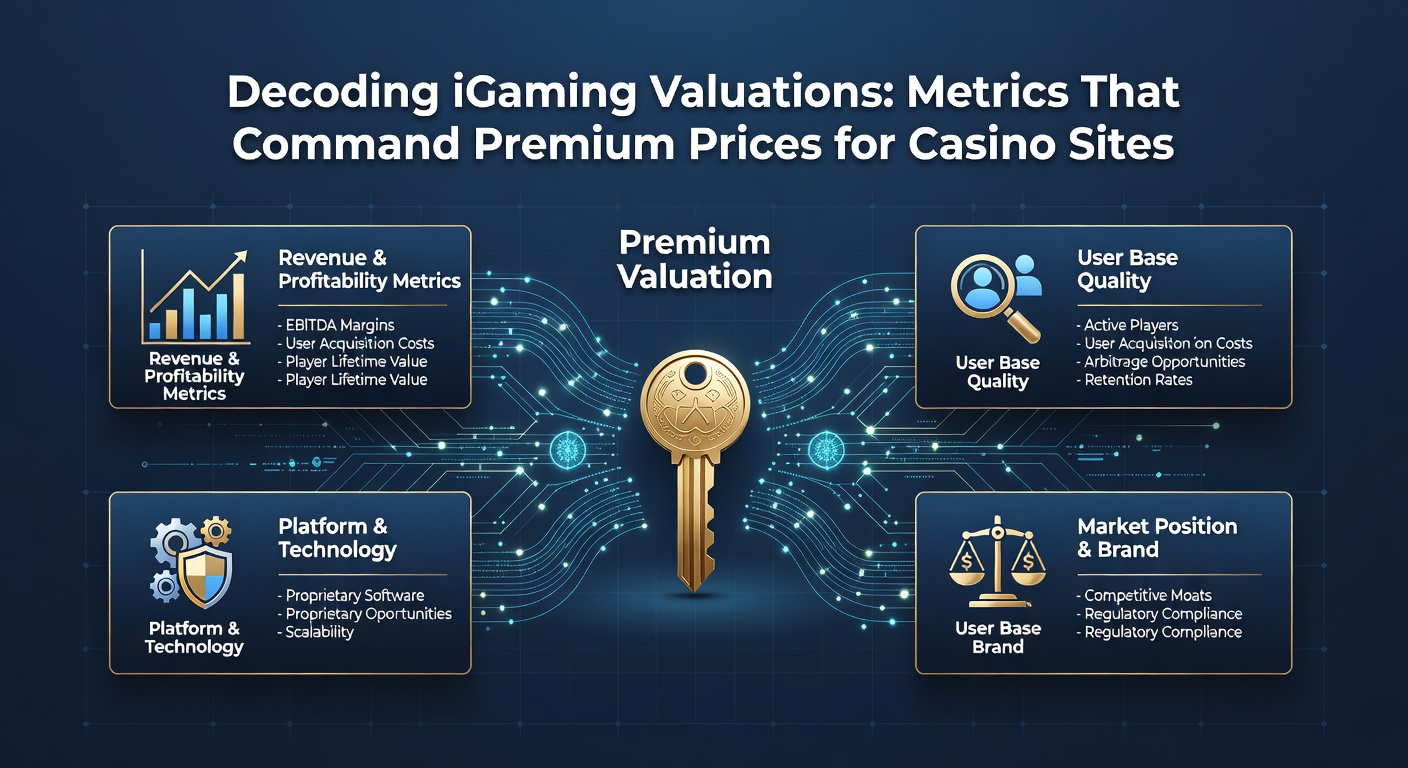
Valuations in iGaming boil down to a symphony of metrics—GGR for scale, EBITDA for profits, player stickiness for sustainability, and licenses for trust—where alignment catapults casino sites into premium territory; transactions analyzed across continents reveal that buyers pay up for platforms blending these elements into scalable, compliant powerhouses. As markets mature toward 2026, those metrics will only sharpen, rewarding operators who track them obsessively. The ball's now in the sellers' court to showcase their numbers, turning data into deals that reshape the landscape.